As an artist, I get asked a lot about landscape and travel photography, and one of the comments I hear frequently is that if I taught a photography course, people would want to attend. To be completely honest, it’s not that I’m ignoring the feedback—I am listening. I think about this a lot in my downtime. And I'm stuck in the dilemma of how do I teach it? Because how I approach art is an extension of who I am. If I build this course, my goal isn't to train you to see the world through my eyes—it’s to help you unlock how you naturally see it. Art shouldn't be about replicating another artist’s style; it should be a process of self-discovery that brings out your own unique vision.
I'm not a professionally trained photographer. I may have years of experience as a photographer and as a multi-disciplinary artist, but my lens is natural. What I did learn was how to operate a professional camera, but even so, I don't know much about the technical modes a camera actually offers. I only know the basics: power on, power off, capture, record. When I worked as a portrait photographer for someone else I learned the basic indoor lighting setups and how to connect them. In my personal practice though, my vision does most of the work for me. I don't scout locations. I don't hunt for the perfect view. I don't wait for the perfect moment. I just show up and snap whatever is right in front of me. All that's left after that is editing to bring out the colors, if needed, which is also driven by my vision.
If I'm completely honest, sometimes I don't even remember where my images are from or which time of day—sunrise or sunset. Most are taken on the road.
As someone who innately sees everything as art, I had to realize that my baseline isn't everyone else's baseline. The more I understand who I am and how I approach my craft, the more I realize that teaching someone how I naturally see the world is extremely difficult. It comes down to reflexes, precision, geometry, and everything in between that I don't even think about because, together, it just looks good to me.
I can teach you how to train your mind to see things from certain angles, and I could send you out to a landscape to hunt for a composition all day. But if your mind isn't tuned to value existence for what it is, you can sit in front of the most beautiful view and miss it completely. In contrast, you can have the most confusing or unclear image in the world but if you don't have the vision for it, you won't know how to repurpose it to make it useful, meaningful, or captivating.
(Yes, it's very possible. Every image can be saved. I repurpose my images all the time—good and bad ones.)
It's one thing to teach technical skills to someone who already has the eye. It's another to teach composition to someone who already has the technical skills. But it's an entirely different universe to teach both at once—to make it feel like second nature, like breathing, where you can be sitting in a moving car and still capture a stunning view in a fraction of a second.
My favorite piece of advice for anyone interested in photography is this: before you take a picture, think about your intention. What is it about this exact moment that you want to capture? Once you have a clear intention, everything starts clicking. Geometry will start directing your eyes and your posture to help you find that perfect frame.
As for reflexes, it isn't just about clicking a button quickly—it's about steadiness. You can have the fastest finger in the world, but if you can't hold the camera steady, the shot won't turn out. One of my favorite activities for sharpening reflexes is boxing. Whenever my reflexes feel off in general, I box. I knew boxing helped me in many ways, but I didn't recognize this perspective until years ago while teaching a friend. Trying to teach hands and footwork at the same time was overwhelming for us both, so we focused on footwork first. Through this experience I realized that your hands follow your feet. As long as your footwork is locked in, your upper body moves fluidly because your foundation is leading the way. In the same way, when your physical base is steady, your hands will be steady.
If you want to measure where your skills currently sit, test for your baseline:
Vision Baseline (Mood Boarding): Are you good at mood boarding—whether digitally or in your head? If you can already envision a mood, your only job is to experiment with a camera until you capture that feeling.
Technical & Framing Baseline (Creating Mood): Are you good at creating a mood in real-time? If so, you just need to identify your anchor. When you look through the frame, can you find the catalyst of that mood and center your image around it?
One test measures your visual instinct, and the other measures your technical application.
If you lack both right now, that's completely fine. Take the test anyway—it will reveal which side you naturally lean toward so you know exactly where to begin.
I hope this helps you too. Those that asked me directly before found it helpful. And, I promise I'm thinking about the course. The request has been sitting on my mind for the past 4 years quietly, and heavily in the past 2 years. Now that I'm back in the creative arena fully, I'll let you know when I've finished breaking down the instinct into something simple enough to teach, if that day ever comes. In the meantime, you can also send me an invitation to work with you and I can help you bring your vision to life, or you can come work with me at Behind Your Shadow, LLC and we'll use your choice of art to help you master yourself 😉.
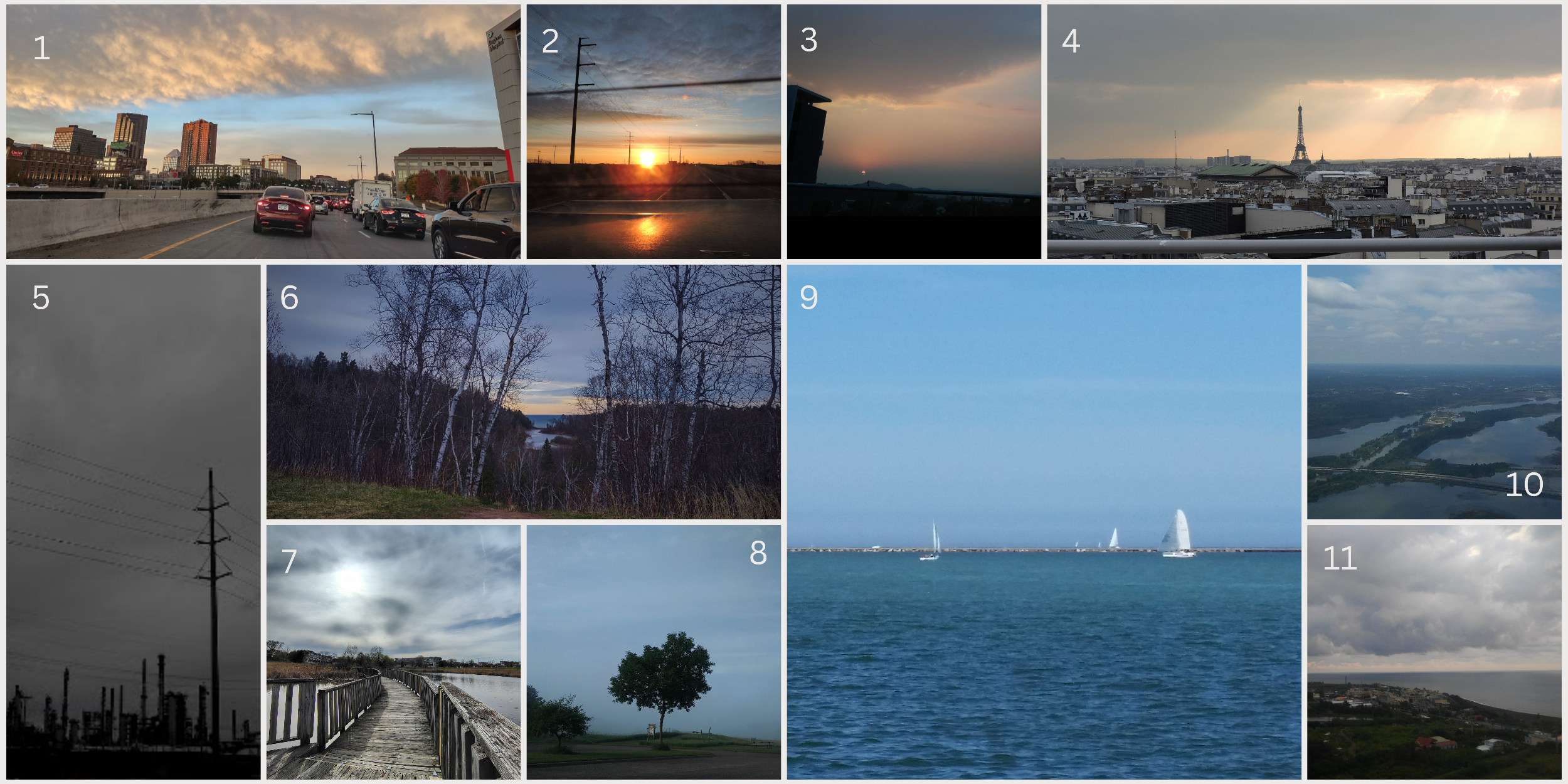
Anyway, based on these images, where do you think they were taken? Drop your guesses in the comments!
(It's a combination of I do and I don't recall moments even for me.)
1. Can you guess which ones were taken from a still point versus a moving vehicle? There are more of them than you might think!
2. Fun fact: Out of all 11 images, I think only three are edited (I'm not sure about one of them, so I'll throw that one in). Care to guess which three?
3. Were these captured during intentional sightseeing trips, or are they just true passerby moments from my daily routine?